More Than Just Oversized, Louis Vuitton Turns Coats Into Mountains
With shepherd capes, architectural shoulders and natural materials, cold-weather clothes are blown up into wearable shelters.

Summary
- The Louis Vuitton Fall/Winter 2026 womenswear collection starts from the founder’s journey from the Jura to Paris, reworking nature, travel and nomadic culture into architectural clothing.
- The collection opens with an oversized cape inspired by the Kepenek used by Turkish shepherds to shield themselves from wind and rain, reinterpreted with a brushed texture, leather‑trimmed wool and exaggerated shoulders.
- Coats in black, camel and ivory almost completely wrap the body, paired with large Monogram travel bags so that these warm pieces also evoke ideas of protection, movement and exploration.
If there’s just one piece to remember from Louis Vuitton’s Fall/Winter 2026 collection, it’s probably these coats, so large they could almost hide a whole person.
In black, camel, and ivory, the silhouettes extend dramatically outward from the shoulders, with the arms nearly disappearing into the heavy materials. As the models approach from afar, they seem to be carrying a small mountain they can take with them rather than simply wearing a winter coat.
These giant coats are part of Nicolas Ghesquière’s Louis Vuitton Fall/Winter 2026 womenswear collection. Drawing on founder Louis Vuitton’s journey from the Jura Mountains to Paris on foot, the collection transforms forests, wind and snow, nomadic life, and cold-weather clothing from different regions into futuristic silhouettes.
- Related reading: Stylish Women Should Know AREA 02: Why Has It Become a New Gateway to Style? Sneakers, Luxury Goods, and Collectibles Are All Here!
Not just oversized: turning a coat into architecture

images from/Louis Vuitton
Even when an oversized coat is scaled up, you can still make out the basic structure of the shoulders, waist, and sleeves. This time, Louis Vuitton deliberately blurs the body’s original outline. The shoulder line extends beyond the body and flares outward on either side, while the front wraps around the wearer in a huge arc.
From the front, these looks resemble capes as much as shields against wind and snow. Rather than falling along the body, the garments first create a broad outer space for the wearer to step into.
The black version has an almost mysterious, imposing presence; camel calls to mind mountains and earth; ivory resembles rocks blanketed in snow. Chunky piping, exposed seams, and thick surfaces further emphasize the traces of handcraft, turning an everyday piece meant for warmth into the architectural centerpiece of the entire look.
A shepherd’s cold-weather cloak, enlarged into high fashion

images from/Louis Vuitton
The enormous cloak that opens the collection references the Kepenek worn by Turkish shepherds. Made from thick materials that envelop the body, this traditional garment was originally designed to protect against wind, rain, and low temperatures outdoors.
On the Louis Vuitton runway, the practical shepherd’s cloak is reworked with brushed textures, leather-trimmed wool, and more extreme sculptural proportions. It retains its sense of protection, yet no longer simply prioritizes ease of movement. Instead, it makes the wearer appear huge and unfamiliar, even like a traveler from a futuristic fable.
The collection as a whole is not simply a direct copy of any one traditional garment. Through architectural silhouettes, Nicolas Ghesquière seeks out the shared ways different cultures dress in response to the natural environment. Wind, rain, snow, and sunlight are no longer just a backdrop to the show; they seem to participate in the design itself, shaping the clothes into shells that shield against the elements.
From the Jura to Paris, travel once again becomes the starting point for clothing

images from/Louis Vuitton
Founder Louis Vuitton was born in 1821 in Anchay, in the Jura Mountains. At 14, he left his hometown alone and walked across France to Paris. This journey, which began in forests and mountains, later became the starting point of the brand’s spirit of travel.
The Fall/Winter 2026 show was held in the Cour Carrée at the Louvre in Paris. Jeremy Hindle, the production designer behind the series “Severance,” transformed the venue into an abstract landscape in mossy hues, with sharp geometric forms. Models emerged from it in giant cloaks, as if they were making their way from the Jura Mountains to Paris.
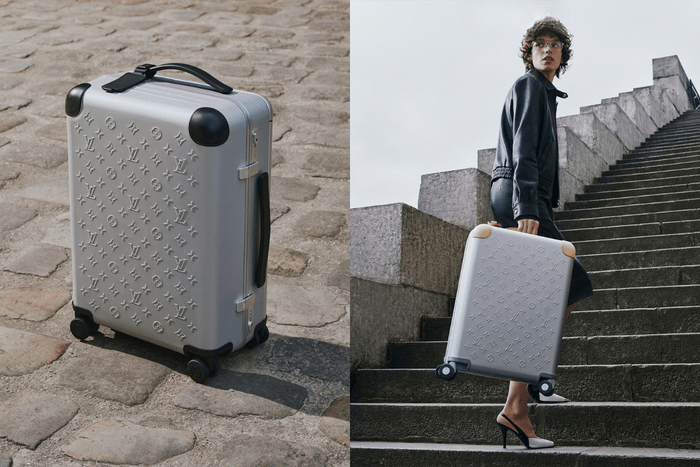
The oversized Monogram travel bags featured in the looks also reconnect the surreal coats with the brand’s familiar language of travel. The coats are shelters built around the body, while the bags hold the things to be taken along. Together, they portray a group of travelers about to leave familiar surroundings for an unknown world.
What makes this Louis Vuitton collection most memorable isn’t a larger logo, but the sheer space a coat can occupy. When the shoulders are as broad as mountain ranges and the material as thick as a barrier, getting dressed is no longer just about flattering the figure; it becomes a way of temporarily building yourself a shelter you can carry with you.
Join Popbee Circle and subscribe to the Popbee newsletter for the latest updates, and be among the first to learn about exclusive perks and discounts! Beyond this article, here are a few recent stories also worth checking out:
- More Than Just Mooncakes: Singapore Prada Caffè’s Limited Mid-Autumn Gift Box Turns Black-and-White Go Pieces into Cookies
- You don’t have to do anything, just sit and look at the mountains! At Yangshuo’s Tianqingse, coffee time turns into a natural meditation
- From Mondrian-inspired facade to multi-million jewelry: what highlights are hidden in Louis Vuitton’s new Taichung store?